
Overview

Retro Sony PlayStation Repair

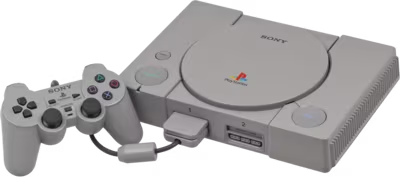
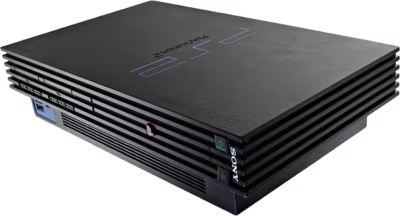
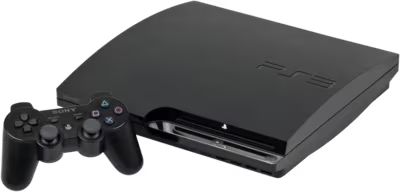
Retro Sony console repair at Brentworth covers the PlayStation, PlayStation 2, and PlayStation 3 — three generations that defined Sony's position in the home console market from 1994 through to the PS4 era, and each with a distinct repair profile shaped by its hardware design and age.

The PlayStation and PS2 are both disc-based systems where optical laser degradation is the primary fault — both platforms depend on ageing CD and DVD laser assemblies that are now between 20 and 30 years old. The PS3 faces a different challenge: the Yellow Light of Death (YLOD) caused by BGA solder joint failure on the Cell Broadband Engine or RSX graphics processor, compounded by the significant thermal stress the fat PS3 models accumulated over years of operation.

All three platforms have active modding communities and well-established software solutions that extend their utility — FreeMCBoot and OPL on the PS2, and CFW or HEN on the PS3. Brentworth handles both repair and modification services for retro Sony hardware — describe the console model, the fault, and any modification requirements in the intake form.

Ready to start?

Use the intake form to describe the device, the fault, and the result you want. The more specific you are, the easier it is to give you a useful answer.

Start Repair
Models we repair

Choose your model

Select your PlayStation console for fault-specific repair information.

Common Issues

What we fix

Disc laser degradation on PS1 and PS2

Both the PlayStation and PlayStation 2 depend on optical disc lasers that are now over two decades old. The PS1's CD laser assembly — using the same KSM-440 laser mechanism across most production runs — degrades progressively, producing FMV errors and audio skips as early symptoms before advancing to general disc read failures. The PS2 fat models use a dual-lens assembly (one for CD, one for DVD) that adds complexity to diagnosis. Laser potentiometer adjustment restores marginal lasers; replacement is required for lasers beyond adjustment. ODE installations eliminate the laser dependency entirely for PS1 and PS2 owners who want a permanent solution.

YLOD on PS3 fat models

The Yellow Light of Death is the PS3's equivalent of the Xbox 360's RROD — a failure of the BGA solder joints on the Cell Broadband Engine processor, the RSX graphics chip, or both, caused by thermal cycling stress accumulated over years of operation. Fat PS3 models (CECHA, CECHB, CECHC, CECHE) are the most affected, having been operated at high thermal loads and accumulated the most years of thermal stress. YLOD repair involves BGA reball or reflow of the failed chip — reflow (heating the existing solder without removing and replacing the ball grid) provides shorter-term relief, while reball (full removal and replacement of the BGA) is the more durable repair.

Capacitor degradation on PS2 fat power supplies

PS2 fat models (SCPH-10000 through SCPH-50000 series) use electrolytic capacitors in their power supply section that are now over 20 years old. Capacitor failure in the PS2 fat PSU produces symptoms including failure to power on, spontaneous shutdown during play, or unstable operation. The surface-mount capacitors on the PS2 fat PSU are a known failure point, and preventative capacitor replacement is a recommended service for PS2 fat units that are to be kept in regular use. PS2 slim models use a smaller, simpler PSU with fewer capacitor concerns.

Common Questions

Frequently asked questions

Can you install FreeMCBoot or OPL on my PS2?

Yes. FreeMCBoot is a memory card exploit that allows the PS2 to load unsigned software from the memory card slot at startup, enabling Open PS2 Loader (OPL) and other homebrew. OPL allows game loading from USB storage or a network share, eliminating disc dependency. Installation requires a compatible PS2 memory card and a method to trigger the initial exploit — this can be done at Brentworth as part of a service. FreeMCBoot is compatible with most PS2 fat and slim models; the very last PS2 slim production runs (SCPH-9xxxx) patched the exploit and are not compatible.

What is YLOD and can my PS3 be repaired?

The Yellow Light of Death (YLOD) is a hardware failure indicated by the PS3's red standby light turning yellow before the console powers off completely. It is caused by BGA solder joint failure on the Cell processor, the RSX graphics chip, or both — the result of thermal cycling stress accumulated over years of operation at high temperatures. Fat PS3 models are most susceptible. YLOD repair via BGA reball is possible and can restore operation for an extended period, but the success rate depends on the extent of the underlying damage. Describe the model number (on the sticker on the console's base) and any history of prior overheating in the intake form.

My PS1 skips during FMV sequences. Is the laser failing?

Yes. FMV (full motion video) skipping and audio dropouts during video sequences are a classic early symptom of PS1 laser degradation. The PS1 uses CD-ROM for all data including video, and the higher sustained read demands of FMV streaming expose marginal lasers that can still load menus and game data. If FMV skipping is the current symptom, the laser is likely in early decline — laser potentiometer adjustment may extend its service life, but replacement or ODE installation is the more reliable long-term solution. Do not wait until the console stops reading discs entirely before servicing.

Can you install an ODE on a PS1 or PS2?

Yes. The PSIO is the primary ODE for the PS1, connecting through the parallel port on compatible models to allow game loading from SD card. The PS2 has several ODE options including the PHOEBE and POPSTARTER-based solutions that allow loading from USB or network without the disc drive. ODE installation is particularly recommended for PS1 and PS2 units where the disc drive has failed and replacement laser parts are becoming scarce, or for owners who want to eliminate the mechanical drive as a point of failure. Describe the console model and preferred loading method in the intake form.

Which PS3 models are most at risk of YLOD?

The original fat PS3 models — particularly the 60GB CECHA and CECHB, which also included PS2 hardware backward compatibility — accumulated the most thermal stress over their lifetimes due to their higher TDP and older thermal paste. The CECHE and CECHG fat models followed. PS3 slim and super-slim models run cooler and have significantly lower YLOD rates, though they are not immune. The CECHA 60GB model is especially worth preserving for its full PS2 backward compatibility — it contains actual PS2 hardware (Emotion Engine and Graphics Synthesizer chips) and is the only PS3 that plays PS2 discs natively.

Can you install CFW or HEN on my PS3?

Yes. Custom firmware (CFW) can be installed on PS3 models with firmware version 3.55 or lower, which in practice means fat and first-generation slim models. HEN (Homebrew ENabler) is available for later slim and super-slim models on current official firmware. Both enable game backup loading, PS1 and PS2 compatibility improvements, and homebrew. Describe the PS3 model and current firmware version in the intake form if known. Note that CFW/HEN installation affects system software and online functionality — describe the intended use case so the appropriate approach can be confirmed.

Is there a diagnostic fee for retro Sony console repair?

Yes. Brentworth charges a non-refundable diagnostic fee that is credited toward the repair cost if you proceed. The fee covers physical inspection, disc drive or power assessment, and a written fault report. For YLOD repair, the diagnostic process includes thermal assessment and a realistic assessment of reball viability before any work is quoted.

Ready to start?

Use the intake form to describe the device, the fault, and the result you want. The more specific you are, the easier it is to give you a useful answer.

Start Repair

Related services

specialist work

Retro Consoles

Retro repair, restoration, and mod work for older consoles with aging parts, fragile boards, and video or drive issues.

View all services